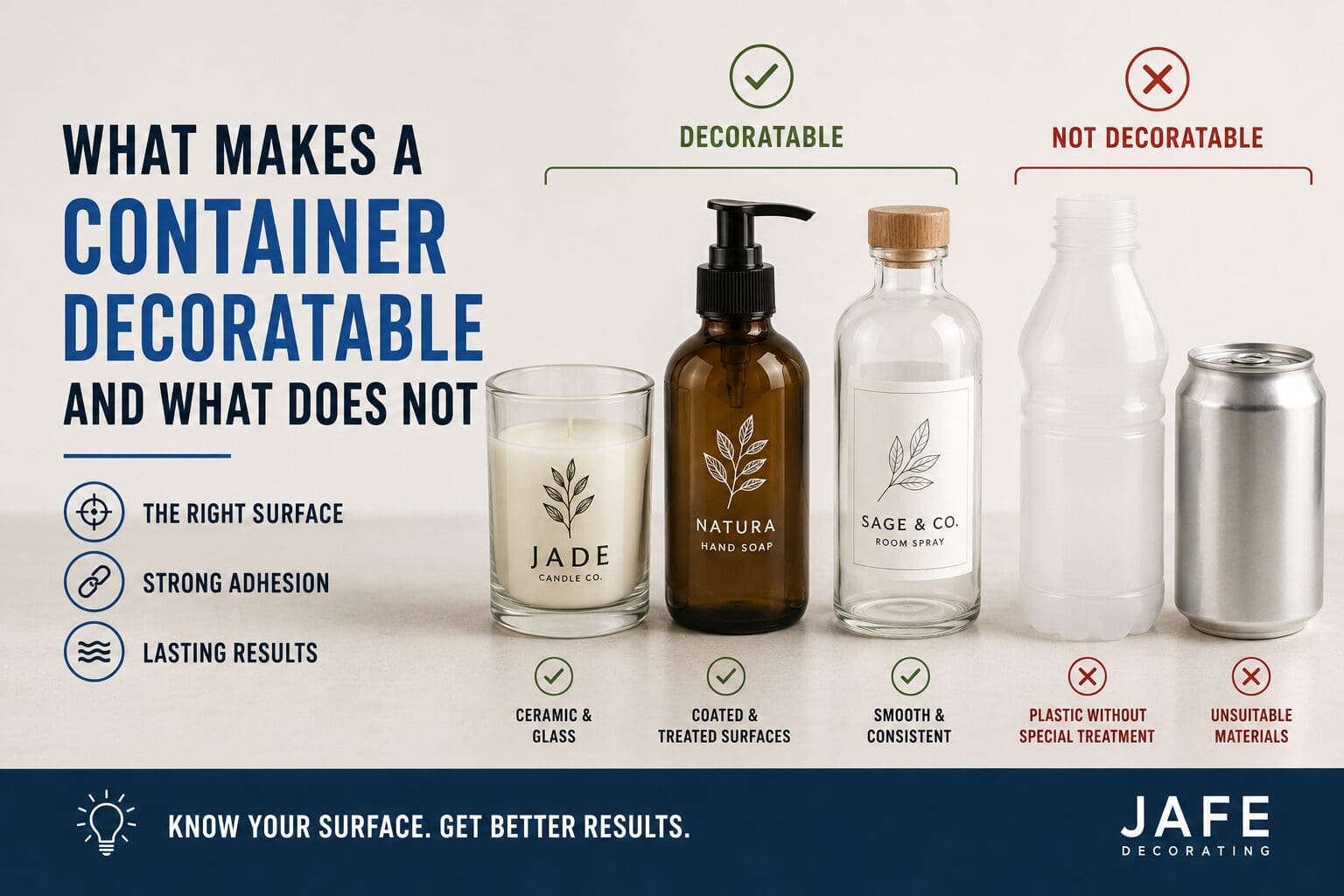
Not every container that looks good will perform well in decoration.
This is one of the most common disconnects in product development. A container may look right visually, but once decoration begins, issues can start to appear.
Understanding what makes a container suitable for decoration helps prevent those issues before they start.
Why “Decoratable” Matters
Decoration is not just about applying a design. It depends on how the material, surface, and shape respond to the process.
Two containers can look nearly identical but behave very differently during production.
That difference often comes down to factors that are not visible at first.
1. Surface Energy and Adhesion
One of the biggest factors in decoration is how well the surface allows ink or coatings to bond.
Some materials naturally support adhesion. Others require additional treatment.
If surface energy is too low, decoration may not bond properly. This can lead to scratching, peeling, or inconsistency over time.
What to consider:
- Material type
- Surface condition
- Whether treatment is required before decoration
2. Coatings and Surface Treatments
Some containers include coatings that are not immediately visible but affect how decoration performs.
These coatings can interfere with adhesion and durability.
What to consider:
- Whether the container has any protective or functional coatings
- How those coatings interact with decoration methods
- Testing on actual production containers, not just samples
3. Material Type
Glass, plastic, and aluminum each behave differently in decoration.
- Glass generally offers strong compatibility and consistency
- Plastic varies depending on the material and may require surface treatment
- Aluminum requires specific preparation and processes
The material itself sets the foundation for how decoration will perform.
4. Shape and Curvature
Container shape plays a major role in how designs are applied.
Flat or gently curved surfaces tend to produce more consistent results.
More complex shapes can introduce challenges with alignment, distortion, and coverage.
What to consider:
- Where the design will be placed
- How the surface curves or tapers
- Whether the shape supports consistent application
5. Consistency Across Batches
Even when using the same container, variation can occur between production batches.
These differences can affect how decoration behaves, especially at scale.
What to consider:
- Consistency from the supplier
- Testing across multiple batches when possible
- Monitoring results during production
Common Situations to Watch For
Some containers appear suitable but create challenges later.
Examples include:
- Glass with surface coatings that affect adhesion
- Plastics with low surface energy
- Shapes that distort or shift the design
These are not unusual cases. They are common patterns that can be identified early.
How to Evaluate a Container Early
A more reliable approach is to evaluate decoration as part of the initial container decision.
That includes:
- Testing with actual production containers
- Reviewing how the design will be applied
- Considering how the product will be handled and used
Looking at these factors early helps reduce adjustments later.
Where Issues Typically Show Up
When a container is not well suited for decoration, issues tend to appear during production.
Common signs include:
- Adhesion differences
- Color inconsistency
- Misalignment or distortion
These are usually not isolated problems. They reflect how the container and process interact.
A More Reliable Approach
When container selection, design, and decoration are aligned early, results tend to be much more consistent.
Most challenges are not caused by the decoration process itself. They come from how materials and conditions interact.
Accounting for those factors upfront leads to a smoother path from sampling to production.
Quick Takeaways
- Not all containers are equally suited for decoration
- Surface energy, coatings, and material type all influence results
- Shape and consistency play a major role at scale
- Early evaluation helps prevent production issues
- Alignment between container and process improves consistency
Closing
Choosing a container is not just about appearance. It is about how that container performs throughout the entire production process.
Understanding what makes a container decoratable helps create more predictable results and reduces the need for adjustments later.