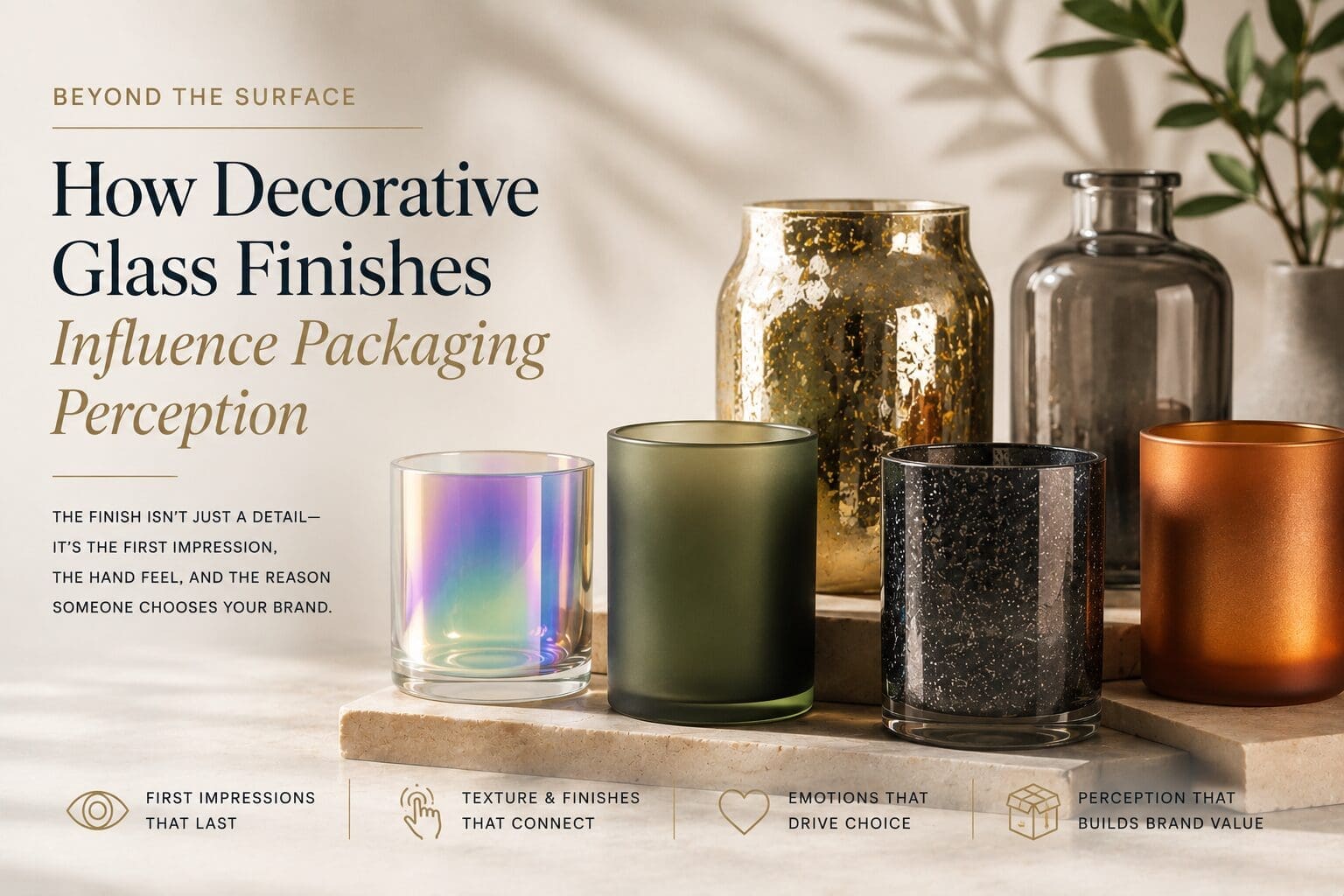
Packaging starts working before a customer ever opens the product.
A glass container may feel calm and understated. Bright and reflective. Soft and premium. Clean and minimal. Bold and expressive. Much of that first impression comes from the surface itself.
Color matters, but finish, texture, sheen, and reflection all play a role in how packaging is seen, held, and remembered. For brands developing candles, fragrance, beauty, spirits, food, or lifestyle products, decorative glass finishes can help shape the feeling of a collection before the product inside is ever experienced.
That is why finish decisions are worth thinking through early in the project.
Why Surface Matters in Packaging Design
Customers do not experience packaging as separate parts. They see the full package at once: the glass shape, color, decoration, finish, artwork, closure, label, and product category all working together.
Surface finish affects how those elements come across.
A matte finish can soften the entire presentation. A gloss finish can make color feel brighter and more polished. A reflective finish can add movement under light. Frosting can create a softer, more diffused look. Screen printing can make branding feel crisp and intentional.
The right finish does more than make a package look nice. It helps support the brand story.
Finish Can Change Perceived Value
Two glass containers with the same shape and color can feel very different depending on the finish.
A soft, diffused surface may feel more restrained and premium. A high-gloss finish may feel more energetic and retail-forward. A reflective accent may make the package feel more collectible or high impact. A layered combination of matte, gloss, print, or metallic detail can create more depth than one finish alone.
These choices influence how customers interpret the product.
For example, a wellness candle collection may benefit from a soft matte or silk finish that feels quiet and calming. A limited-edition fragrance launch may call for more reflection, contrast, or visual movement. A beauty brand may want clean screen printing and controlled color to support a more precise, polished look.
The finish should match the feeling the brand wants to create.
Matte, Gloss, and Reflection All Tell a Different Story
Sheen is one of the most noticeable ways a finish changes perception.
Matte finishes often feel soft, grounded, modern, and understated. They can work well for tonal packaging, wellness-inspired collections, quiet luxury aesthetics, and brands that want a less reflective surface.
Gloss finishes often feel brighter, more polished, and more visible. They can help color feel more saturated and create a more retail-forward look.
Reflective finishes can create movement as light changes across the surface. This can be useful for statement packaging, seasonal collections, prestige-inspired visuals, or products that need stronger shelf presence.
None of these options is automatically better than the others. The stronger choice depends on the product category, brand position, artwork, lighting environment, and overall packaging system.
Decorative Methods Shape the Brand Impression
Finish is only one part of the decision. The decoration method also affects how the final package feels.
Screen printing is often used when a brand wants crisp, direct-to-glass artwork with clean lines and strong visual control. It works well for logos, simple branding systems, and premium packaging that needs a clear hierarchy.
More immersive decoration approaches can create a fuller surface story, especially when artwork, gradients, or allover visuals are part of the concept.
Specialty coatings, frosting, metallic effects, interior or exterior coatings, and layered finish combinations can all change the way the glass interacts with light and color.
The important question is not simply, “Which decoration looks best?” A better question is, “Which decoration supports the way this brand should feel?”
Layered Finishes Can Add Depth
Many modern packaging systems are moving beyond one finish at a time.
A brand may combine a soft coating with a reflective accent. A matte surface may be paired with gloss decoration. A tonal coating may use contrast through print or sheen. A full-surface decoration may be balanced with clean graphic elements.
When done well, layering can make packaging feel more intentional and dimensional.
The key is restraint. Layered finishes should support the package, not overcrowd it. Too many effects can compete with the product instead of strengthening it.
That is where sampling and review become important. A finish combination may look good in a concept rendering, but the real test is how it behaves on the actual glass, under real light, with the final decoration.
Questions to Ask Before Choosing a Finish
Before choosing a decorative glass finish, it helps to slow down and ask a few practical questions:
- What feeling should the package create in-hand and on-shelf?
- Should the surface feel soft and atmospheric or bold and reflective?
- How will the finish interact with the glass shape?
- Does the decoration support the brand direction?
- Is the goal visibility, restraint, immersion, or contrast?
- Will the finish work with the artwork, color, and product category?
- How important is light reflection to the overall effect?
- Does the project need sampling before production approval?
These questions help move the conversation from “What looks nice?” to “What supports the brand and production goals?”
How JAFE Can Help
JAFE works with brands on decorative glass finishes, custom coatings, screen printing, frosting, specialty effects, and candle filling support. Our role is to help customers think through what may work for their project, how different finishes can affect the final look, and what needs to be reviewed before production.
For new projects, sampling is generally required before production unless the project is a reorder. Sampling helps confirm appearance, color, decoration, and manufacturability before moving forward.
If you are exploring a new finish direction, the best place to start is with the look and feeling you want the package to create. From there, JAFE can help talk through decoration options and next steps.
Download the Surface & Perception Guide
Our Surface & Perception guide looks at how decorative finishes shape modern packaging through texture, sheen, reflection, and surface combinations.
It covers silk coatings, reflective color, screen printing, sublimation, matte and gloss contrast, layered finishes, and key questions to ask before choosing a finish direction.
Download the guide to start planning your next glass packaging project with more intention.
FAQs
What are decorative glass finishes?
Decorative glass finishes are surface treatments or decoration methods that change the appearance and feel of glass packaging. These may include coatings, frosting, matte or gloss finishes, metallic effects, screen printing, and specialty decoration.
How does finish affect packaging perception?
Finish influences how light, color, texture, and artwork are experienced. A matte finish may feel softer and more understated, while a gloss or reflective finish may feel brighter and more visible.
Is matte or gloss better for glass packaging?
Neither is better for every project. Matte finishes often support softer, modern, or restrained packaging. Gloss finishes can support brighter, polished, or high-impact packaging. The right choice depends on the brand, product category, and desired customer experience.
Do I need a sample before production?
For new projects, sampling is generally required before production unless the project is a reorder. Sampling helps confirm the final look, decoration quality, color, and production feasibility.
Can JAFE help choose a finish?
Yes. JAFE can help customers review decorative finish options, coatings, screen printing, frosting, specialty effects, and sampling needs based on the project goals.