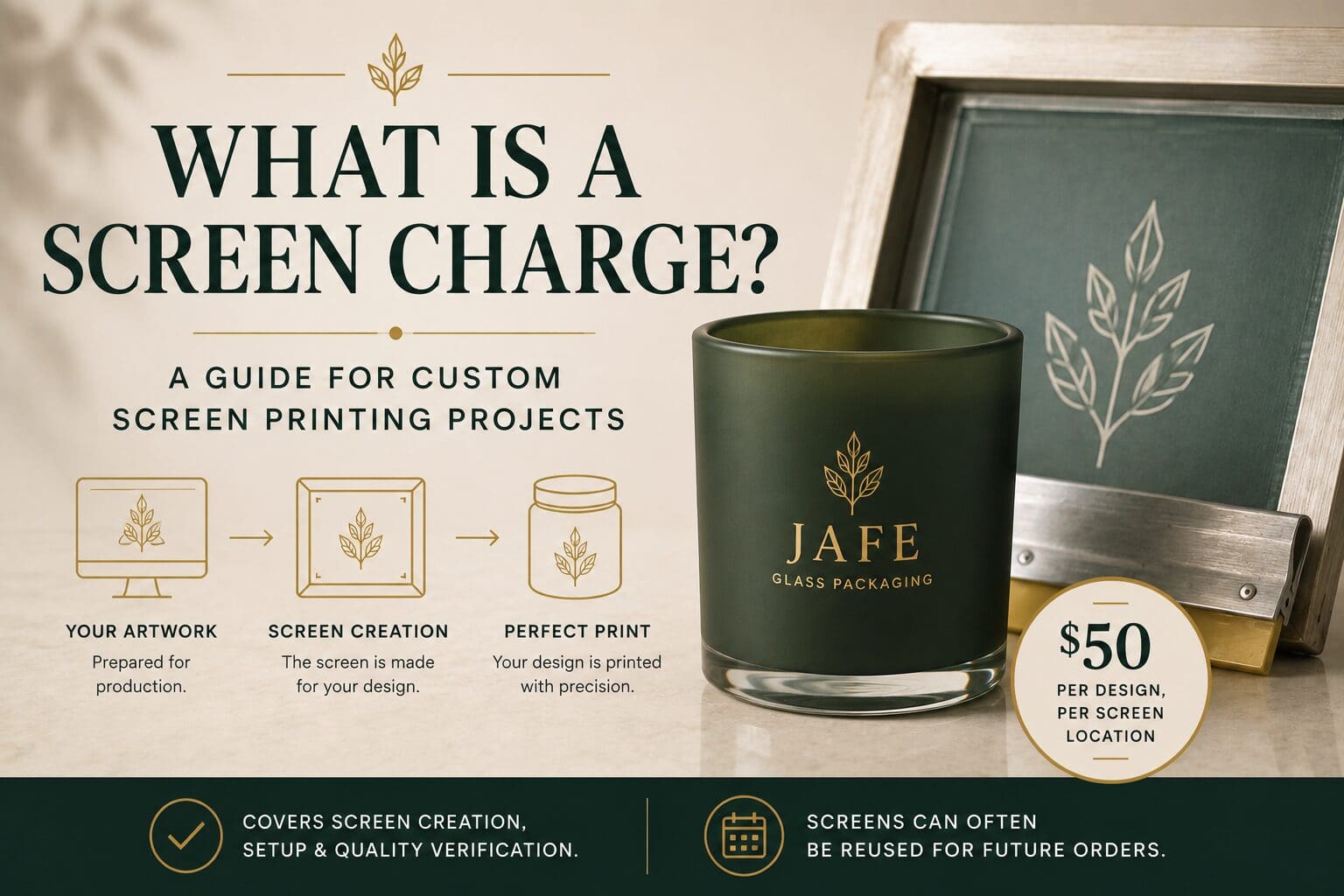
If you’re exploring custom screen printing for candle vessels, perfume bottles, spirits packaging, or other glass containers, you’ve likely come across the term screen charge.
For many first-time buyers, it raises an immediate question:
What exactly is a screen charge, and why is it required?
The answer is simple. A screen charge covers the creation of the screen used to transfer your artwork onto the container during the screen printing process.
Understanding how screen charges work can help you budget more accurately, plan future projects, and better understand the production process behind custom decorated packaging.
What Is a Screen Charge?
A screen charge is a setup fee associated with creating the screen used during screen printing.
Before any printing can begin, your artwork must be prepared and transferred onto a specialized screen that will be used during production.
The screen acts as the tool that allows ink to be applied to the container in the shape of your design.
Without the screen, the printing process cannot take place.
How Much Is a Screen Charge?
JAFE’s standard screen charge is:
$50 per design, per screen location.
This charge covers the preparation and creation of the production screen used for printing your artwork.
Why Is a Screen Charge Necessary?
Unlike labels or digital graphics, screen printing requires physical production equipment to reproduce artwork on the container surface.
Creating the screen involves:
- Artwork preparation
- Screen production
- Setup procedures
- Production testing
- Quality verification
The screen charge helps offset the cost of preparing these materials before production begins.
Does Every Screen Printing Project Require a Screen Charge?
Most custom screen printing projects require at least one screen charge.
The number of screens required depends on factors such as:
- Number of print colors
- Number of print locations
- Artwork variations
- Container size differences
The more complex the design, the more screens may be required.
Does Each Color Require Its Own Screen?
Yes.
In most screen printing applications, each print color requires its own screen.
For example:
One-Color Logo
A simple gold logo printed on a candle vessel would typically require one screen.
Two-Color Design
A logo printed in gold and white would typically require two screens.
Each color must be printed separately, which requires its own production screen.
Does Each Print Location Require Its Own Screen?
Yes.
If artwork appears in multiple locations on the same container, additional screens may be required.
For example:
- Logo on the front
- Product information on the back
These are considered separate print locations and may require separate screen preparation.
Can Existing Screens Be Reused?
In many cases, yes.
If a future order uses:
- The same artwork
- The same print size
- The same print location
- The same production specifications
existing screens may often be reused.
This is one reason repeat projects can be more efficient than initial production runs.
Is a Screen Charge a One-Time Fee?
For many projects, the screen charge is primarily associated with creating the initial screen.
If future orders use the same artwork and specifications, new screens may not always be required.
However, artwork changes, size changes, or production changes may require new screen creation.
What Happens If I Change My Artwork?
Artwork changes often require new screen preparation.
Examples include:
- New logos
- Revised graphics
- Different text
- New product names
- Additional print colors
Because the screen is built specifically for a particular design, significant artwork revisions usually require a new screen.
Is a Screen Charge the Same as Artwork Setup?
Not exactly.
Although they are related, they serve different purposes.
Artwork Setup
Involves preparing artwork files for production.
This may include:
- File review
- Vector conversion
- Artwork adjustments
Screen Charge
Covers the creation of the physical production screen used during printing.
Both may be required depending on the project.
Why Is Screen Printing Still Worth It?
Even with screen charges, many brands choose screen printing because of the benefits it provides.
Advantages include:
- Premium appearance
- Direct-to-container decoration
- Strong durability
- Professional branding
- Consistent reproduction
For many candle, fragrance, and spirits brands, screen printing helps create packaging that feels more integrated and elevated than traditional labels.
Common Screen Charge Questions
What is a screen charge?
A screen charge is a setup fee that covers the creation of the screen used during screen printing.
How much is JAFE’s screen charge?
JAFE’s standard screen charge is $50 per design and screen location.
Does every color require a screen?
Yes. Each print color typically requires its own screen.
Can screens be reused?
In many cases, existing screens can be reused when artwork and production specifications remain unchanged.
Is a screen charge a one-time fee?
Often, the initial screen creation is the primary charge. Future projects using the same specifications may not require new screen creation.
Understanding Screen Charges Helps You Plan Better
Screen charges are a normal part of the screen printing process and play an important role in creating accurate, professional decoration.
By understanding how screens are created, why they are necessary, and how they affect project planning, brands can make more informed decisions when developing custom packaging.
Whether you’re decorating candle vessels, perfume bottles, spirits packaging, or cosmetic containers, understanding screen charges helps create a clearer picture of the production process and the investment required to bring custom packaging to life.