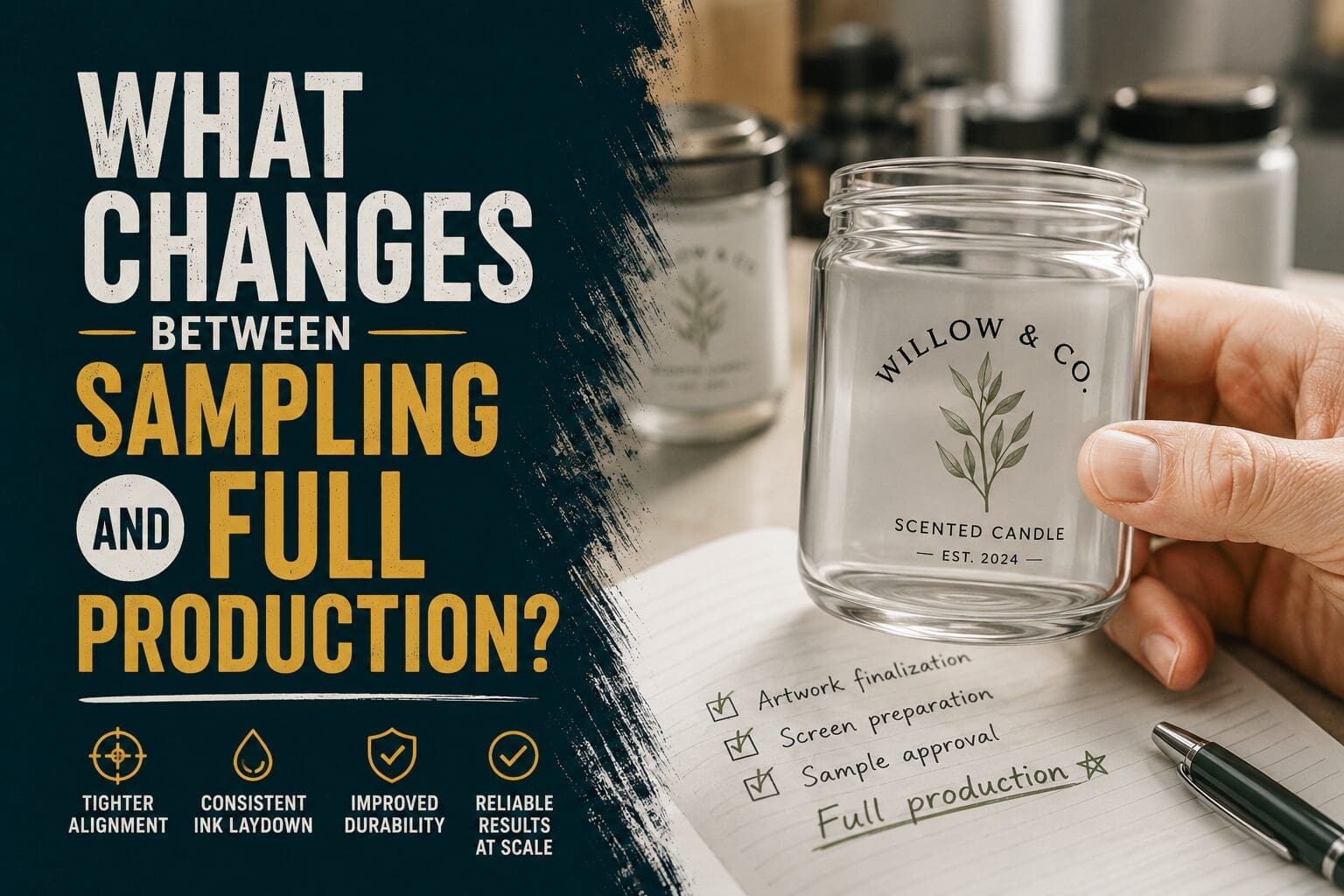
One of the most common assumptions in packaging development is that once a sample is approved, production will look exactly the same.
In reality, sampling and production are very different environments.
That does not mean production is unpredictable. It means that scale introduces additional variables that need to be accounted for early.
Understanding what changes between sampling and full production helps create more consistent results and reduces surprises later in the process.
Why Sampling and Production Are Different
A sample is typically produced in a controlled environment with a small quantity of units.
Production introduces:
- Higher volume
- Faster throughput
- More handling
- Variation across batches and materials
These conditions affect how decoration performs over time and at scale.
1. Scale Changes the Process
What works consistently on a small sample set may behave differently across thousands of units.
At production scale:
- Small variations become more visible
- Process consistency matters more
- Speed and handling influence results
This is why production is not just a larger version of sampling. It is a different operating environment.
2. Material Variation Becomes More Noticeable
Even when using the same container type, variation can occur between batches.
These differences may affect:
- Color appearance
- Coating adhesion
- Print alignment
- Surface consistency
At sample quantities, these variations may not be obvious. At production scale, they become easier to detect.
This is why evaluating consistency across runs matters just as much as approving the initial sample.
3. Production Conditions Are Different
Sampling is usually done under tightly controlled conditions.
Production introduces additional variables such as:
- Equipment setup across longer runs
- Environmental conditions
- Production speed
- Curing consistency
- Handling during filling and packing
Even when the process is controlled, these factors can influence the final result.
4. Visual Expectations Change at Scale
A single sample is viewed differently than a full production run.
When products are grouped together, even subtle variation becomes more noticeable.
This is especially true with:
- Color consistency
- Alignment
- Surface finish
- Coverage and opacity
That is why experienced teams focus on maintaining controlled ranges and repeatability, not just matching one unit visually.
5. Real-World Conditions Start to Matter
A sample is usually evaluated before the product is fully used, filled, packed, or shipped.
Production introduces real-world conditions such as:
- Heat exposure
- Friction during handling
- Shipping movement
- Interaction with product contents
These conditions can affect how decoration performs after production is complete.
Testing under actual use conditions helps create a more reliable outcome.
Why Process Control Matters
Consistency from run to run does not come from the sample alone.
It comes from:
- Working from defined standards
- Maintaining controlled production conditions
- Validating materials and setup
- Monitoring consistency across batches
When those systems are in place, production becomes much more predictable.
How Experienced Teams Reduce Variation
Reducing variation starts with planning for production early, not reacting later.
That includes:
- Testing on actual production containers
- Reviewing color under real conditions
- Designing with process limitations in mind
- Validating alignment and adhesion during production runs
The earlier these factors are considered, the smoother the transition from sampling to production tends to be.
A More Reliable Approach
Sampling is an important step, but it is only part of the process.
The most consistent results come from understanding how materials, production conditions, and scale interact across the full production cycle.
When those elements are aligned early, the transition into production becomes much more controlled and repeatable.
Quick Takeaways
- Sampling and production are different operating environments
- Scale introduces additional variables and visibility
- Material variation becomes more noticeable at production volume
- Consistency comes from process control, not a single sample
- Testing under real conditions improves predictability
Closing
Moving from sampling to production is not just about increasing quantity. It is about maintaining consistency as more variables enter the process.
Understanding what changes during that transition helps create a smoother path from approval to full production.