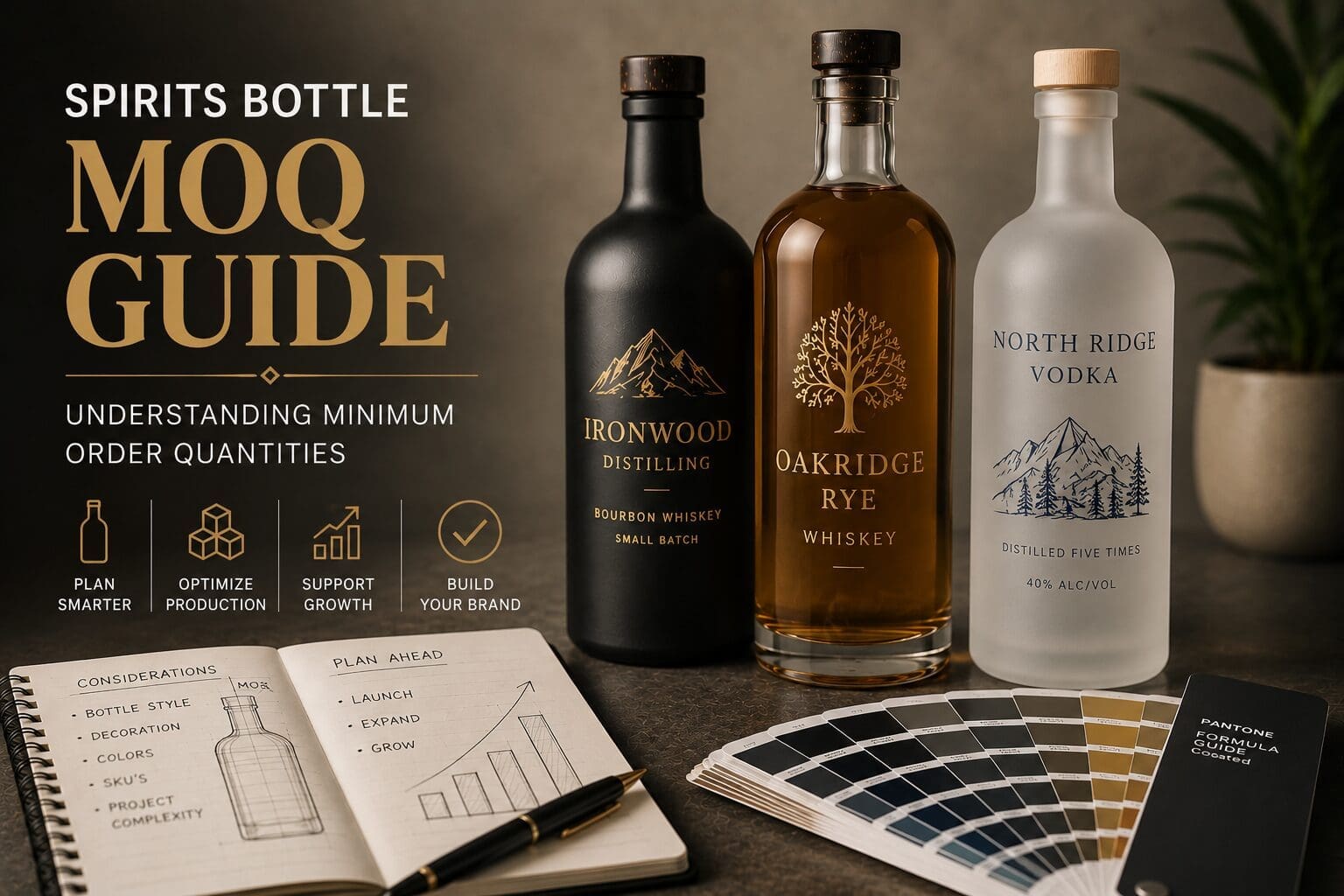
When planning a custom spirits bottle, one of the first questions many brands ask is, “What is the minimum order quantity?”
Minimum order quantities, often referred to as MOQs, are a standard part of custom manufacturing. Understanding how they work can help you plan your project, estimate production needs, and make informed packaging decisions.
In this guide, we’ll explain what MOQs are, why they exist, and how they fit into the development of custom spirits packaging.
What Is an MOQ?
MOQ stands for Minimum Order Quantity.
It is the smallest production quantity that can be manufactured for a specific project.
Minimum order quantities help manufacturers efficiently schedule production, manage materials, and maintain consistent quality throughout the manufacturing process.
Why Do Minimum Order Quantities Exist?
Custom bottle decoration involves more than applying artwork to glass.
Before production begins, several steps take place, including:
- Artwork preparation
- Screen creation
- Color development
- Equipment setup
- Production scheduling
- Quality inspections
These activities require time and resources regardless of the final order quantity. Establishing minimum order quantities helps make custom manufacturing practical and repeatable.
Does Every Project Have the Same MOQ?
Not always.
Minimum order quantities can vary depending on several factors, including:
- Bottle style
- Decoration method
- Number of colors
- Project complexity
- Production requirements
Your project requirements help determine the appropriate production quantity.
What Is a SKU?
A SKU, or Stock Keeping Unit, identifies a unique version of a product.
Changes such as:
- Bottle color
- Decoration
- Artwork
- Product name
- Bottle size
may create separate SKUs.
Planning your SKUs early can help simplify production and inventory management.
How Do Multiple SKUs Affect Production?
Many spirits brands offer several products within the same collection.
For example:
- Bourbon
- Rye
- Gin
- Vodka
Each product may have its own artwork, bottle color, or decoration.
Understanding your full product lineup during the planning stage helps create a more efficient production schedule.
Should I Plan for Future Growth?
Yes.
Many successful brands begin with one or two products and expand over time.
Thinking ahead can help create:
- Consistent branding
- Coordinated packaging
- More efficient product launches
- Easier inventory planning
A well-planned packaging system can support future additions without requiring a complete redesign.
How Can I Make the Most of My Production Run?
Planning ahead often creates opportunities for greater efficiency.
Consider:
- Forecasting future demand
- Coordinating multiple product launches
- Standardizing bottle styles where appropriate
- Developing a long-term packaging strategy
Early planning can make future production runs easier to manage.
Common MOQ Questions
Why do manufacturers have minimum order quantities?
Minimum order quantities help account for the preparation, setup, and production work required for custom decorated bottles.
Can different bottle colors be combined?
Every project is unique. Depending on the decoration requirements and bottle selection, different product variations may be treated as separate SKUs.
Does each design require its own screen?
For screen printing projects, each design and print location typically requires its own screen.
Can I start with one product and expand later?
Yes. Many brands launch with a single product and add additional SKUs as their business grows.
When should I discuss production quantities?
Production quantities are best discussed early in the planning process so they can be considered alongside decoration methods, artwork, and production scheduling.
Planning for Long-Term Success
Minimum order quantities are an important part of custom manufacturing, but they are only one piece of the overall planning process.
By understanding how production quantities, SKUs, artwork, and decoration methods work together, you can make informed decisions that support both your current launch and future growth.
Starting with a clear production plan helps create a smoother development process and provides a strong foundation for future product expansions.