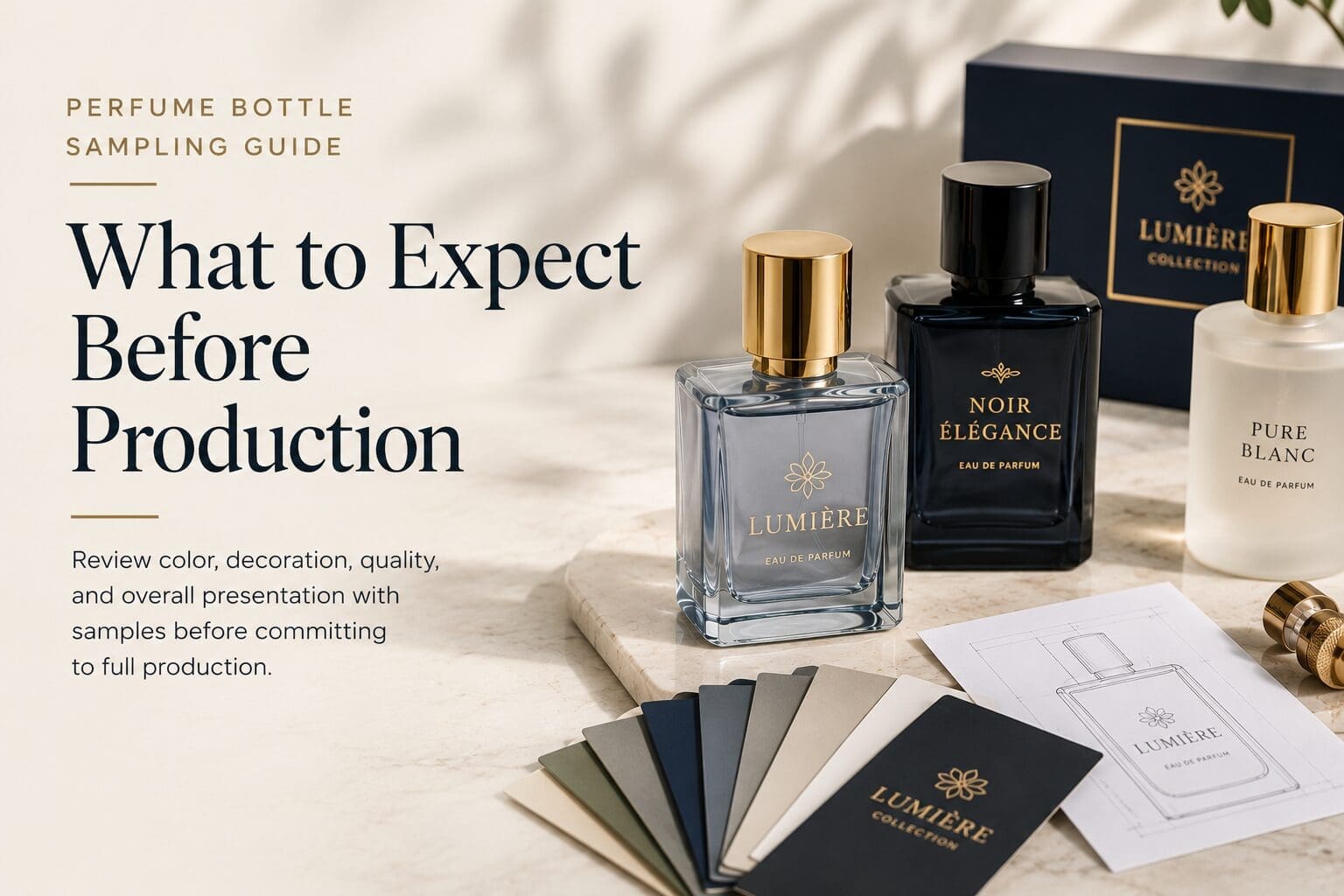
Before committing to a production order, most fragrance brands want to answer one important question:
What will my finished perfume bottle actually look like?
That’s where sampling comes in.
Sampling allows fragrance brands to evaluate bottle appearance, decoration quality, color development, artwork placement, and overall presentation before moving into production.
Whether you’re launching your first fragrance or expanding an established collection, reviewing samples can help you make informed decisions and move forward with greater confidence.
In this guide, we’ll explain how perfume bottle sampling works, what to expect during the process, and why sampling is one of the most valuable steps in fragrance packaging development.
What Is a Perfume Bottle Sample?
A perfume bottle sample is a small production run created for evaluation before a full production order is placed.
Samples allow brands to review:
- Bottle appearance
- Decoration quality
- Custom colors
- Artwork placement
- Closure compatibility
- Overall presentation
Rather than relying solely on digital renderings or artwork proofs, sampling provides an opportunity to see and handle the actual decorated bottle before approving production.
Why Is Sampling Important?
Luxury fragrance packaging is highly visual.
Small differences in color, finish, decoration, or bottle appearance can significantly influence how consumers perceive the product.
Sampling allows brands to evaluate these details before committing to production quantities.
Evaluate Color Development
Colors often appear differently on physical glass than they do on a computer screen.
Sampling allows brands to review:
- Transparent colors
- Opaque colors
- Matte finishes
- Gloss finishes
- Frosted appearances
Physical samples help ensure the final result aligns with the intended brand aesthetic.
Review Decoration Quality
Sampling provides an opportunity to evaluate:
- Screen printing accuracy
- Artwork placement
- Logo visibility
- Print clarity
- Overall decoration appearance
This helps reduce uncertainty before production begins.
Assess the Complete Package
Many fragrance brands use samples to review how all packaging components work together.
This may include:
- Bottle color
- Decoration
- Cap selection
- Closure finish
- Secondary packaging concepts
Viewing the complete package helps create a more cohesive final product.
How Much Do Perfume Bottle Samples Cost?
Sampling costs vary depending on:
- Bottle specifications
- Decoration requirements
- Color development
- Number of sample variations
- Project complexity
Project-specific sampling requirements should be reviewed during development.
Can I Sample Multiple Bottle Colors?
Yes.
Many fragrance collections include multiple bottle colors or finish options.
Sampling multiple colors allows brands to compare variations and determine which option best supports the fragrance collection.
Examples may include:
- Clear glass
- Frosted glass
- Matte black
- Transparent amber
- Opaque white
- Custom brand colors
Reviewing options side by side often leads to stronger packaging decisions.
Can Decoration Be Included in Samples?
Yes.
Decoration methods such as screen printing can often be included during sampling.
This allows brands to review:
- Logo placement
- Artwork size
- Decoration visibility
- Print quality
Decoration samples help ensure the final production package aligns with brand expectations.
What Should I Evaluate During Sampling?
The most successful sampling process evaluates more than just appearance.
Consider reviewing:
Bottle Appearance
- Color consistency
- Finish quality
- Surface appearance
- Visual impact
Decoration
- Logo clarity
- Artwork placement
- Print quality
- Brand visibility
Components
- Cap fit
- Closure appearance
- Component compatibility
Photography Readiness
Many fragrance brands use samples to begin planning:
- Product photography
- Marketing materials
- Retail presentations
- Launch campaigns
Evaluating samples under real-world lighting conditions can reveal details that are difficult to identify in digital proofs.
Can Sampling Help With Collection Development?
Absolutely.
Many fragrance brands use sampling to compare:
- Multiple bottle colors
- Decoration variations
- Collection concepts
- Packaging directions
Sampling helps brands make decisions before committing to larger production quantities.
What Happens After Sample Approval?
Once samples are approved, the project can move into production planning.
This typically includes:
- Final artwork approval
- Decoration specification review
- Quantity confirmation
- Timeline approval
- Production scheduling
Approving samples before production helps create a smoother path toward launch.
Common Perfume Bottle Sampling Questions
Why should I order perfume bottle samples?
Sampling allows you to review decoration quality, color development, artwork placement, and overall presentation before production.
Can multiple bottle colors be sampled?
Yes. Many fragrance brands sample multiple color options before selecting a final direction.
Can screen printing be included in samples?
Yes. Decoration methods such as screen printing can often be included as part of the sampling process.
Are samples recommended before production?
Yes. Sampling is one of the most valuable tools available for reducing uncertainty and improving decision-making.
Can samples be used for product photography?
Many brands use approved samples for photography, marketing materials, and launch planning.
Building Confidence Before Production
Sampling is one of the most important steps in fragrance packaging development.
It allows brands to evaluate bottle appearance, compare decoration options, review color development, and confirm design decisions before committing to production quantities.
Whether you’re developing a signature fragrance, launching a luxury collection, or preparing for retail expansion, investing time in the sampling process can help create a stronger finished product and a smoother production experience.
By reviewing physical samples before production begins, fragrance brands can move forward with greater confidence and build packaging that accurately reflects their vision.