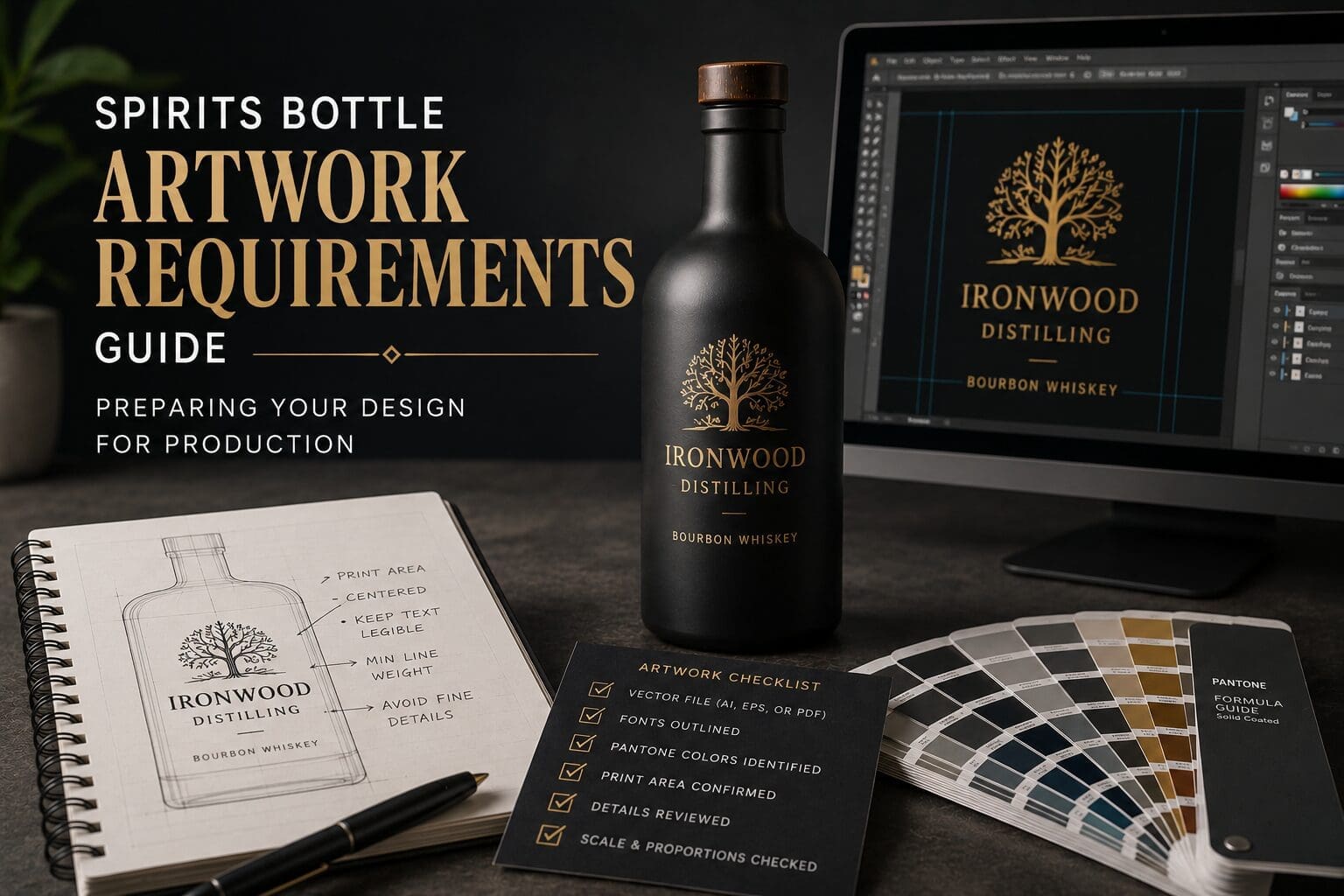
A great bottle design starts with great artwork.
Even the best decoration methods cannot produce the desired results if artwork is incomplete or not prepared for production. Taking the time to organize your files before submitting a project helps reduce revisions, improve communication, and keep your project moving forward.
Whether you’re decorating a whiskey bottle, vodka bottle, tequila bottle, gin bottle, or another spirits container, understanding artwork requirements will help create a smoother production process.
Why Artwork Preparation Matters
Artwork serves as the blueprint for your decorated bottle.
Production-ready files help ensure that logos, text, and graphics are reproduced accurately and positioned correctly on the container.
Preparing artwork before sampling can also reduce unnecessary delays and revisions.
What File Types Are Preferred?
Vector artwork is typically preferred for screen printing projects because it can be resized without losing quality.
Preferred file formats include:
- Adobe Illustrator (.AI)
- Encapsulated PostScript (.EPS)
- Vector PDF
If you’re unsure whether your artwork is vector, your graphic designer can usually confirm the file type.
What Is Vector Artwork?
Vector artwork is created using mathematical paths instead of pixels.
Unlike image files, vector artwork remains sharp and clear at any size.
This is especially important when artwork is applied to curved glass surfaces where precision matters.
Can I Submit a PNG or JPG?
PNG and JPG files may be useful as visual references, but they are generally not suitable for production.
These file types can lose quality when enlarged and often require recreation before they can be used for screen printing.
Whenever possible, provide the original vector artwork.
Should Fonts Be Outlined?
Yes.
Outlining fonts converts text into vector shapes so the artwork appears exactly as intended.
This prevents font substitutions that can occur if the production team does not have the original typeface installed.
Designing for a Curved Bottle
Unlike a flat sheet of paper, glass containers have curved surfaces.
When designing artwork, consider:
- Print area limitations
- Curved viewing angles
- Logo placement
- Text size
- Spacing between design elements
Simple, well-balanced layouts often produce the best results.
Keep Small Details Readable
Very fine lines, intricate details, and extremely small text may not reproduce as expected during screen printing.
As you develop your artwork:
- Maintain adequate line thickness.
- Leave sufficient space between design elements.
- Avoid overly complex patterns.
- Make sure important information remains easy to read.
A clean design often creates a stronger visual impact than one filled with unnecessary detail.
Plan for Multiple Print Colors
If your design includes multiple print colors, each color may require its own screen during production.
When preparing artwork:
- Separate colors clearly.
- Confirm color specifications.
- Identify metallic or specialty inks when applicable.
Clear organization helps streamline production planning.
Consider Bottle Shape During Design
Bottle shape influences how artwork is viewed.
Before finalizing your design, consider:
- Shoulder shape
- Straight versus tapered walls
- Bottle diameter
- Front-facing viewing area
Artwork that works well on one bottle style may need adjustments for another.
Review Artwork Before Sampling
Before requesting a sample, confirm:
- Logos are correct.
- Text has been proofread.
- Fonts are outlined.
- Colors have been identified.
- Vector files are included.
- Artwork is sized appropriately.
Completing these steps early helps reduce revisions later in the project.
Common Artwork Questions
What is the best file type for bottle decoration?
Vector artwork in AI, EPS, or Vector PDF format is typically preferred.
Can I use artwork created in Canva?
It depends on how the artwork is exported. In many cases, additional editing or vector recreation may be needed before production.
Why are outlined fonts important?
Outlined fonts help preserve the appearance of your design and eliminate font compatibility issues.
Can artwork be adjusted after sampling?
Changes may be possible, but revisions can affect timelines and may require additional sampling depending on the scope of the changes.
Should I provide Pantone colors?
If your brand has established color standards, providing Pantone references can help communicate your intended color direction.
Setting Your Project Up for Success
Well-prepared artwork makes every stage of the decoration process more efficient.
Providing production-ready files, reviewing your design carefully, and considering how artwork will appear on the finished bottle can help reduce revisions and create a smoother experience from sampling through production.
A little preparation at the beginning of the project often saves time later and helps ensure the finished bottle reflects your original design intent.