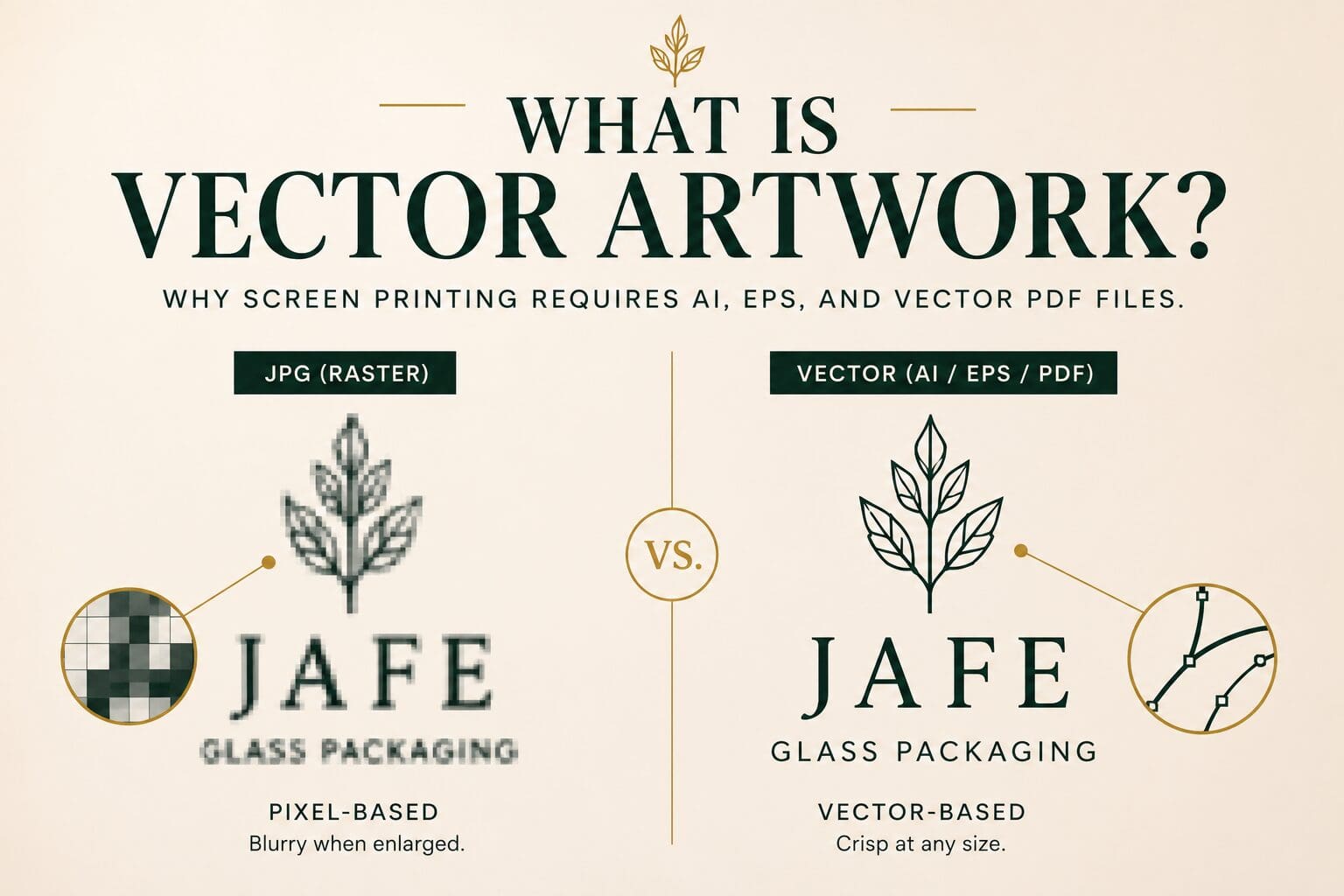
One of the most common questions brands ask when preparing a screen printing project is:
“Why do you need my artwork in a vector file?”
Whether you’re decorating candle vessels, perfume bottles, spirits packaging, or cosmetic containers, artwork quality plays a major role in the final appearance of the printed design.
For screen printing projects, vector artwork is the industry standard because it allows designs to be reproduced accurately, consistently, and at production quality.
In this guide, we’ll explain what vector artwork is, why it’s required for screen printing, common file formats, and how to determine whether your artwork is ready for production.
What Is Vector Artwork?
Vector artwork is artwork created using mathematical paths rather than individual pixels.
Because vector files are built from paths, they can be scaled to virtually any size without losing quality.
This means a logo can be enlarged or reduced while maintaining sharp edges and clean lines.
Vector artwork is commonly used for:
- Logos
- Brand marks
- Text-based graphics
- Product decoration
- Packaging artwork
- Screen printing projects
What Is the Difference Between Vector and Raster Artwork?
Understanding the difference between vector and raster files is important when preparing artwork for production.
Vector Artwork
Built from paths and shapes.
Benefits include:
- Scalable without quality loss
- Sharp edges
- Clean reproduction
- Production-ready for screen printing
Common formats include:
- AI
- EPS
- Vector PDF
Raster Artwork
Built from pixels.
Common raster formats include:
- JPG
- JPEG
- PNG
- GIF
Raster images are typically created for viewing on screens rather than manufacturing processes.
When enlarged, raster artwork often becomes blurry or pixelated.
Why Is Vector Artwork Required for Screen Printing?
Screen printing requires artwork to be converted into production screens.
To create those screens accurately, the artwork must have clearly defined edges and scalable design elements.
Vector artwork provides:
- Precise line definition
- Consistent sizing
- Accurate screen creation
- Cleaner print results
Without vector artwork, achieving professional print quality becomes much more difficult.
What Happens If I Only Have a JPG or PNG?
This is a common situation.
Many businesses have:
- Website logos
- Social media graphics
- Marketing images
but do not have the original vector files.
While JPG and PNG files may appear sharp on a screen, they are often unsuitable for production because they contain pixel-based information rather than scalable paths.
In some cases, artwork may need to be recreated or converted into vector format before screen printing can begin.
How Can I Tell If My Artwork Is Vector?
A few simple clues can help.
You likely have vector artwork if your file ends in:
- .AI
- .EPS
- .PDF (vector-generated)
You may not have vector artwork if your file ends in:
- .JPG
- .JPEG
- .PNG
- .GIF
If you’re unsure, the artwork can be reviewed before production.
Why Does Vector Artwork Improve Print Quality?
Screen printing relies on precision.
Vector artwork helps ensure:
- Sharp logos
- Clean text
- Consistent line thickness
- Accurate reproduction
Small details that appear acceptable on a digital image can become problematic during printing if the artwork is not properly prepared.
Using vector artwork reduces these risks.
What Types of Artwork Work Best for Screen Printing?
The most successful screen printing projects typically use:
- Clean logos
- Simple graphics
- High-contrast artwork
- Clearly defined lines
- Production-ready vector files
Complex artwork may still be possible, but production requirements should always be reviewed during project planning.
Can Text Be Converted to Vector Artwork?
Yes.
Text can often be converted into outlines, which transforms the characters into vector shapes.
This helps ensure that:
- Fonts remain consistent
- Artwork displays correctly
- Production files are stable
Many production-ready files have text converted to outlines before submission.
Does Vector Artwork Cost More?
Not necessarily.
Providing production-ready vector artwork from the beginning can actually reduce delays and simplify the project setup process.
If artwork requires recreation or extensive modification, additional artwork preparation may be required.
Common Vector Artwork Questions
What is vector artwork?
Vector artwork is artwork built from mathematical paths that can be scaled without losing quality.
What file formats are considered vector?
Common vector formats include AI, EPS, and vector-generated PDF files.
Can I use a JPG for screen printing?
JPG files are generally not suitable for production screen creation because they are pixel-based images.
Why is vector artwork required?
Vector artwork helps ensure accurate screen creation, clean print quality, and consistent reproduction.
How do I know if my logo is vector?
Files ending in AI, EPS, or vector PDF are typically vector files. If you’re unsure, the artwork can be reviewed before production.
Preparing Artwork for Success
Artwork preparation is one of the most important steps in any screen printing project.
Providing production-ready vector artwork helps streamline the approval process, improve print quality, and reduce unnecessary delays before manufacturing begins.
Whether you’re decorating candle vessels, fragrance packaging, spirits bottles, or cosmetic containers, starting with the right artwork file gives your project the strongest foundation for success.
If you’re unsure whether your artwork is production-ready, reviewing it before development begins can help identify opportunities for improvement and keep your project moving forward with confidence.