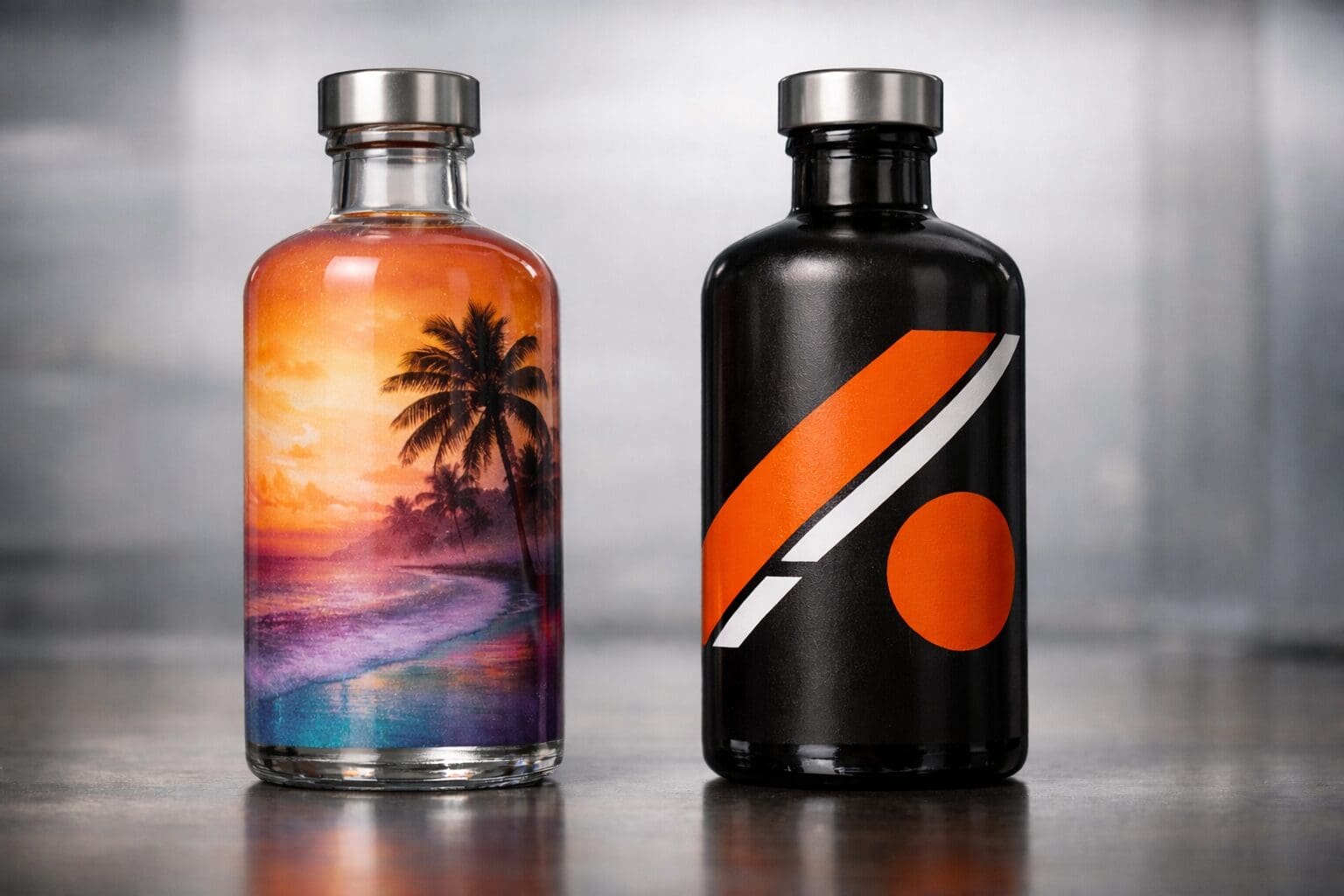
When you are sourcing decoration for a bulk glass bottle, the decision between sublimation vs screen printing is not just about aesthetics. It affects durability, production scalability, ink adhesion, packaging performance, and long-term brand presentation.
At first glance, Sublimation and Screen Printing can both deliver bold decoration. But when applied to glass decoration, especially for high-volume production runs, the differences become significant.
This guide breaks down how each process works, where it excels, and what to consider when choosing the right solution for your bottle program.
Sublimation vs Screen Printing: Process Overview
Understanding the fundamentals of sublimation vs screen printing starts with how each method applies graphics to a bottle surface.
Sublimation is a heat-driven transfer process. Specialized inks are printed onto transfer paper, then heat and pressure convert the ink into a gas that bonds with a coated substrate. Sublimation does not sit on top of the surface. Instead, it becomes part of the coating layer. For Sublimation to work on a glass bottle, the bottle must first be coated with a compatible polymer surface.
Screen Printing, by contrast, pushes ink through a mesh stencil directly onto the bottle. The ink is deposited in controlled layers and then cured through UV or thermal curing processes. Screen Printing bonds directly to prepared glass surfaces using inks engineered for strong adhesion.
For bulk glass container programs, the distinction matters. Sublimation depends on a coating layer. Screen Printing depends on ink adhesion to glass itself.
If your production involves high-volume bottle decoration, the surface preparation requirements will heavily influence your decision.
Surface Preparation and Ink Adhesion on Glass
Glass manufacturing produces a non-porous, smooth surface. That is both an advantage and a challenge.
With Sublimation, you cannot apply the process directly to untreated glass. The bottle must receive a polymer coating compatible with sublimation inks. That coating step adds cost, complexity, and another quality control checkpoint. If coating consistency varies across production runs, sublimation results may shift in color or durability.
With Screen Printing, surface preparation typically involves cleaning and sometimes flame or plasma treatment to improve ink adhesion. Because Screen Printing inks are formulated specifically for glass decoration, they chemically and mechanically bond to the bottle during curing processes.
For brands prioritizing durability, especially in fragrance, spirits, beverage, or cosmetic packaging, strong ink adhesion directly to glass often supports better long-term packaging performance.
If a bottle will experience moisture, handling, transportation friction, or retail shelf wear, the decoration method must withstand that lifecycle.
Print Complexity and Design Capabilities
When comparing sublimation vs screen printing, design complexity is often the first conversation.
Sublimation excels at photographic imagery, gradients, and highly detailed artwork. Because the ink transitions smoothly during the sublimation process, it can produce seamless full-color images. For complex visual storytelling on a bottle, Sublimation offers flexibility.
Screen Printing is traditionally strongest with bold spot colors, logos, typography, and defined graphic elements. While modern Screen Printing can layer multiple colors and achieve high precision, each additional color requires additional screens and setup.
If your brand requires intricate, wraparound artwork across an entire bottle, Sublimation may appear appealing. However, if your design relies on crisp brand marks, metallic effects, specialty inks, or tactile finishes, Screen Printing often delivers superior results.
It is important to match print complexity with production scalability. What looks ideal in a prototype must hold up in bulk glass container production.
Production Runs and Production Scalability
This is where the conversation shifts from creative to operational.
Sublimation is frequently associated with short-run customization. Because each bottle requires heat transfer processing, scaling to large production runs can slow throughput. For bulk glass bottle programs in the tens of thousands or more, Sublimation may introduce bottlenecks.
Screen Printing, especially in automated decorating lines, is built for production scalability. Once screens are prepared and color registration is dialed in, Screen Printing can move rapidly through large production runs with consistent output.
If you are planning recurring orders, national distribution, or seasonal launches with tight timelines, production scalability becomes critical.
In bulk glass decoration, consistency across production runs protects brand integrity. Screen Printing offers predictable repeatability when quality control standards are maintained.
Sublimation may be effective for limited-edition releases, influencer kits, or short promotional campaigns, but less common for sustained large-scale bottle manufacturing.
Durability and Packaging Performance
A bottle is not just a display surface. It must perform.
With Sublimation, durability depends on the integrity of the coating layer. If the coating is compromised, scratched, or exposed to certain chemicals, the decoration may degrade. Sublimation can offer strong resistance when properly applied, but coating variation is a variable that must be controlled.
Screen Printing inks for glass decoration are engineered for abrasion resistance, chemical resistance, and UV stability. During curing processes, the ink forms a hardened bond with the bottle surface.
For fragrance, spirits, beverage, or beauty brands, packaging performance includes:
- Resistance to oils or alcohol exposure
- Dishwasher durability where applicable
- Scratch resistance during shipping
- Long-term color stability
In many bulk glass container applications, Screen Printing is selected specifically because of its durability profile.
If your bottle is part of a refill system, retail environment, or multi-touch consumer experience, the decoration must withstand repeated handling.
Color Accuracy and Quality Control Standards
Consistency matters in glass manufacturing and glass decoration.
With Sublimation, color output can shift based on coating thickness, heat distribution, and pressure application. Tight quality control standards are required to ensure uniform results across batches of bottles.
Screen Printing relies on precise ink formulation and screen calibration. Once dialed in, color matching can remain stable across production runs. Custom color matching is often easier to control in Screen Printing because inks are mixed specifically to brand standards.
For brands with strict Pantone or proprietary color systems, Screen Printing may offer stronger control over repeatability.
Quality control standards should evaluate:
- Adhesion testing
- Abrasion testing
- Batch-to-batch color variance
- Curing validation
No decoration method should move forward without structured testing against real-world conditions.
Cost Considerations in Sublimation vs Screen Printing
Cost analysis must look beyond per-unit decoration pricing.
With Sublimation, costs include coating the bottle, transfer materials, heat processing, and potential throughput limitations. For small production runs, setup may be lower, making Sublimation attractive for limited quantities.
With Screen Printing, there are upfront setup costs for screens and art separation. However, as production runs increase, per-unit costs often decrease significantly.
For bulk glass bottle programs, Screen Printing frequently becomes more cost-efficient at scale.
Brands should evaluate:
- Initial setup investment
- Long-term reorder economics
- Waste rates
- Throughput speed
- Integration with filling and packaging lines
If your bottle moves directly from decoration to turnkey candle filling or fragrance filling, process efficiency becomes even more important.
Sublimation vs Screen Printing: Which Is Right for Your Bottle?
There is no universal winner in sublimation vs screen printing. The right solution depends on your goals.
Choose Sublimation if:
- You require highly detailed, full-color artwork
- You are running short production runs
- The bottle is primarily decorative and lightly handled
- You are launching limited editions or custom personalization
Choose Screen Printing if:
- You need strong ink adhesion directly to glass
- You are producing large production runs
- Durability and packaging performance are critical
- You require consistent brand color matching
- Production scalability is a priority
In bulk glass container manufacturing, Screen Printing remains the more common solution because it aligns with high-volume production and long-term durability expectations.
That said, the smartest approach is not choosing a process in isolation. It is evaluating the full lifecycle of the bottle, from surface preparation through curing processes, quality control, filling, shipping, and retail display.
Final Thoughts on Glass Decoration Strategy
Decoration is not just a finishing step. It is part of your product’s identity.
Whether you explore Sublimation or Screen Printing, your bottle program should account for:
- Glass manufacturing variation
- Surface preparation consistency
- Production scalability
- Packaging performance requirements
- Quality control standards
For bulk glass decoration, clarity about your production runs and durability expectations will guide the right choice.
If your brand is scaling and needs dependable, repeatable glass decoration across thousands of bottles, Screen Printing often provides the operational strength required.
If your project is experimental, artistic, or short-term, Sublimation may support that creative flexibility.
The key is aligning decoration technology with business goals, not just visual preference.
When you evaluate sublimation vs screen printing through the lens of production reality, the right decision becomes much clearer.