Why Glass Packaging Quality Matters More Than You Think
When decoration fails, most brands assume the issue started in the decorating department. The ink, the screen, the curing process. But in commercial production, decorating problems often begin long before decoration ever starts.
They begin with glass packaging quality.
In spirits bottle packaging, wine bottle production, and premium candle containers, the surface you decorate determines whether your decoration performs as intended. If the glass surface lacks consistency, if it carries invisible defects, or if it falls outside commercial tolerances, decoration becomes unpredictable.
At scale, unpredictability is expensive.
Understanding how glass container manufacturing affects decoration performance is one of the most overlooked but critical steps in protecting brand presentation and packaging durability.
The Hidden Link Between Glass and Decoration Performance
Decorating is a surface-dependent process. Ink adhesion, coating uniformity, and long-term durability all rely on surface integrity. When glass packaging quality is compromised, decoration becomes vulnerable.
Common issues tied to glass quality include:
- Surface waviness that disrupts screen printing
- Mold seams that interfere with artwork alignment
- Inconsistent wall thickness affecting curing
- Surface contamination impacting ink adhesion
- Micro-checks and stress fractures weakening packaging durability
Each of these glass defects may appear minor during packaging inspection. But during decorating, they become amplified.
Decoration does not hide glass inconsistencies. It exposes them.
That is why quality control standards in glass container manufacturing directly affect decorating outcomes. If the glass surface is unstable, even the most controlled decoration process cannot compensate.
Common Glass Packaging Defects That Cause Decorating Failures
To prevent decoration issues, you must understand what to look for upstream.
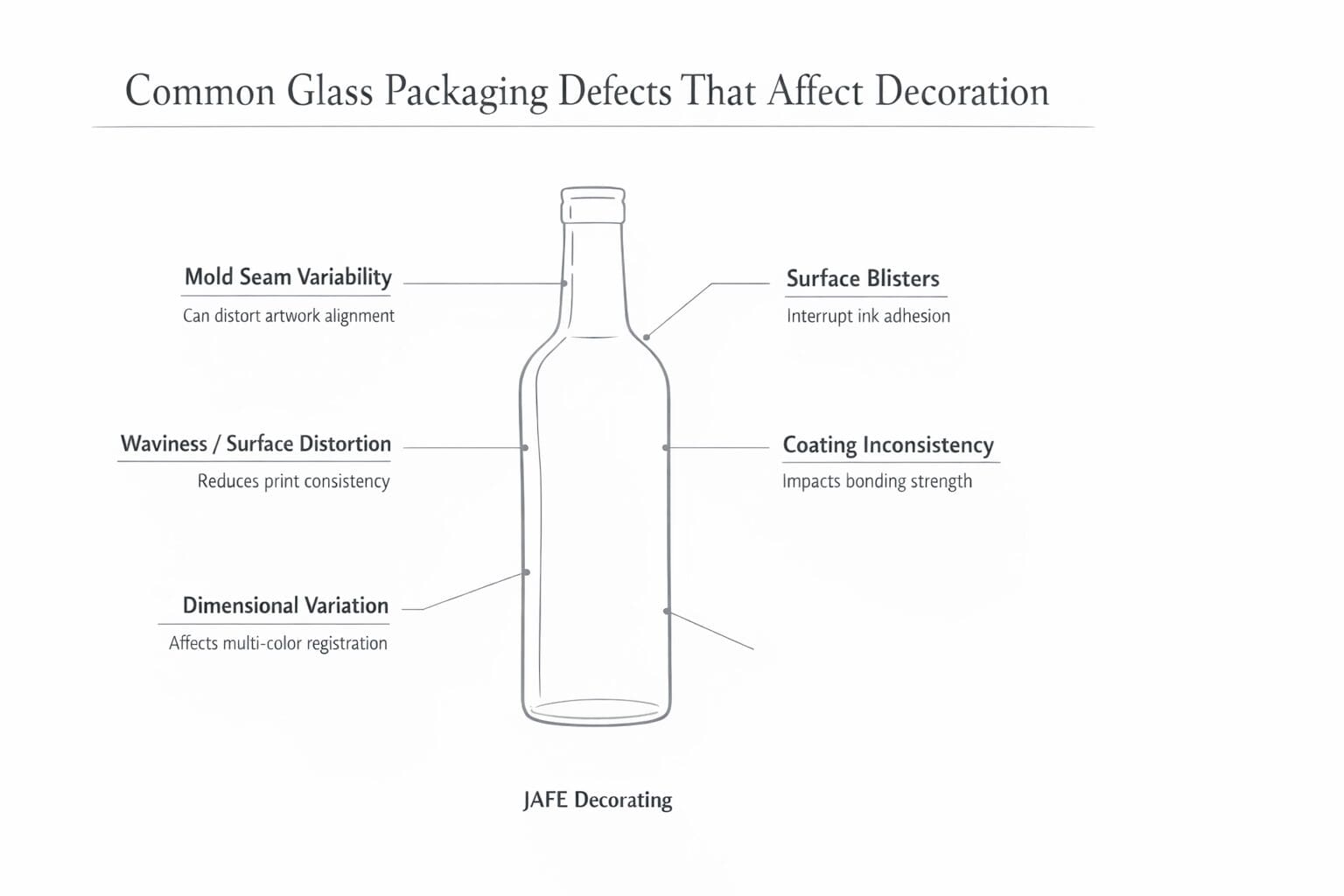
1. Surface Imperfections
Blisters, seeds, bubbles, cords, and stones may not always disqualify glass packaging, but they disrupt decoration consistency. Raised or uneven surfaces prevent uniform ink laydown and reduce adhesion reliability.
2. Mold Seam Variability
In spirits bottle packaging and wine bottle production, mold seams are common. However, excessive seam height or inconsistent placement can distort artwork registration and reduce perceived quality.
3. Surface Coating Variability
Many glass containers receive hot-end or cold-end coatings to improve packaging durability. When these coatings vary in thickness, they can interfere with decorating adhesion.
4. Stress and Annealing Issues
Poor annealing during glass container manufacturing creates internal stress. That stress can affect how the glass responds to heat during curing, increasing the risk of cracking or long-term failure.
5. Dimensional Inconsistencies
Decoration equipment relies on production consistency. Variations in diameter, height, or roundness affect screen contact and artwork placement.
Glass packaging quality is not just about appearance. It is about stability, surface integrity, and repeatability.
How Glass Quality Affects Ink Adhesion and Coating Performance
Paint adhesion is one of the most misunderstood aspects of decorating.
Many assume adhesion is primarily a function of paint formulation. In reality, adhesion depends heavily on the condition of the glass surface.
Glass packaging that carries excess lubricants, surface treatment residue, or contamination reduces bonding strength. Even slight surface chemistry differences can change how ink interacts with the substrate.
For decorative glass finishing processes such as screen printing, spraying, or specialty coatings, consistent surface energy is critical.
If glass packaging quality varies from batch to batch, decorating performance will vary as well.
This is where commercial decoration processes and glass container manufacturing must work in alignment. When the glass surface is controlled, decorating becomes predictable. When it is not, rejection rates rise.
Why Production Consistency Matters in Spirits and Wine Packaging
Spirits bottle packaging and wine bottle production demand visual precision. Shelf presence depends on clean lines, sharp graphics, and durable decoration.
But premium appearance is built on foundational quality.
Inconsistent glass packaging creates:
- Registration shifts in multi-color decoration
- Uneven ink thickness
- Cure variability
- Increased scrap rates
- Reduced packaging durability
In high-volume production, even small glass inconsistencies multiply quickly. A minor dimensional variation becomes thousands of misaligned decorations.
Brands investing in premium decoration should evaluate glass packaging quality with the same intensity they evaluate artwork.
Because no decoration process can fix unstable glass.
Glass Packaging Quality Standards and Quality Control in Manufacturing
Reliable decoration begins with strong quality control standards during glass container manufacturing.
Commercial glass packaging suppliers typically monitor:
- Wall thickness tolerances
- Dimensional accuracy
- Surface defect thresholds
- Annealing performance
- Coating application levels
However, not all glass packaging suppliers apply the same level of quality oversight. And not all packaging is designed with decoration in mind.
For example, decorative glass finishing processes may require tighter tolerances than standard packaging use. What qualifies as acceptable for filling may not qualify as ideal for decorating.
That is why communication between packaging suppliers and decorating partners is critical.
When glass packaging quality requirements are aligned with decoration performance expectations, failure rates drop significantly.
Avoiding Decorating Failures Starts With Glass Quality
Decoration should be the final enhancement step, not a troubleshooting phase.
When brands approach decorating without evaluating glass packaging quality first, they risk:
- Adhesion failures
- Artwork distortion
- Increased waste
- Production delays
- Inconsistent branding
By contrast, when glass container manufacturing quality is assessed before decoration begins, the process becomes stable.
A proactive approach includes:
- Reviewing glass packaging specifications before decoration approval
- Conducting adhesion testing across production batches
- Verifying dimensional tolerances for multi-color decoration
- Evaluating surface integrity prior to decorative glass finishing
- Aligning packaging durability requirements with decoration processes
This is not about placing blame on glass suppliers. It is about understanding the interdependence of packaging and decoration.
Strong glass packaging quality supports strong decoration results.
Building a Decoration Strategy Around Glass Integrity
If your brand relies on premium decoration, start by asking a few direct questions:
- Has the glass packaging been qualified specifically for decoration?
- Are quality control standards documented and consistent?
- Is surface integrity verified before decorating begins?
- Has adhesion testing been performed under real production conditions?
Glass packaging should not be treated as a commodity when decoration performance matters.
Instead, view glass quality as a structural foundation. Decoration enhances the surface, but it depends on that surface being stable, consistent, and controlled.
In spirits bottle packaging, wine bottle production, and other premium markets, decoration is a brand signal. And brand signals cannot afford inconsistency.
The Bottom Line: Protect Decoration by Protecting Glass Quality
Decorating failures rarely start in the decorating department.
They start with surface integrity. With dimensional control. With production consistency. With glass packaging quality.
When glass container manufacturing meets strong quality control standards, commercial decoration processes become predictable. Ink adhesion improves. Packaging durability strengthens. Scrap decreases.
If you want reliable decoration, evaluate glass first.
Because avoiding decorating failures does not begin with ink selection.
It begins with glass quality.