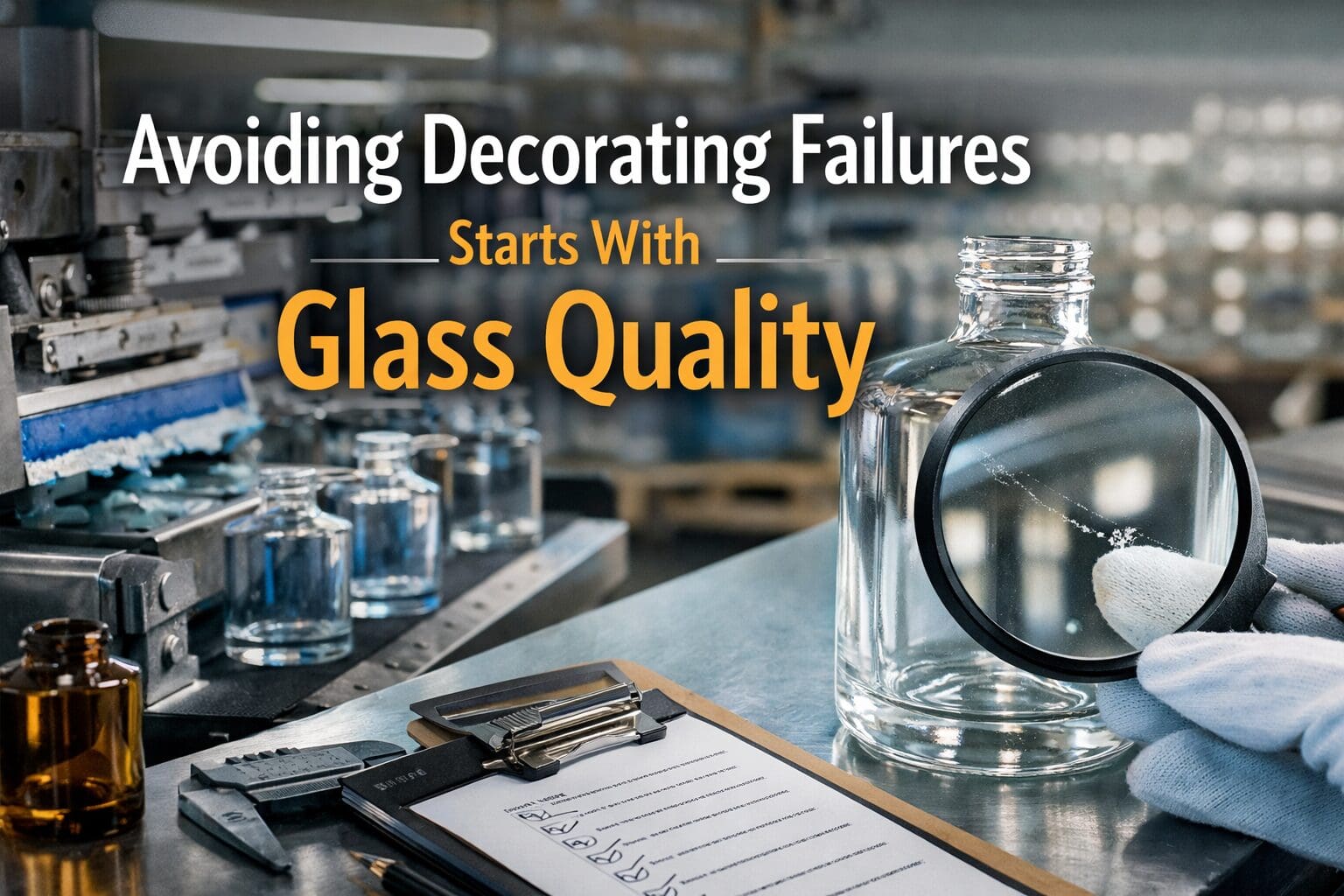
When decorating issues show up late in production, they rarely start in the sampling room. In commercial and mass production environments, the root cause is often upstream. Glass quality is the foundation that determines whether a project runs smoothly or becomes an expensive problem to unwind.
At JAFE Decorating, we see this every day. A beautifully designed glass container can still fail if the underlying quality of the glass vessel does not meet the demands of commercial decorating. Understanding how glass is made, inspected, and controlled is not a nice-to-have. It is essential to protecting timelines, budgets, and brand reputation.
This article explains why glass matters so much, what separates reliable packaging containers from risky ones, and how to evaluate a glass container before it ever reaches decoration.
Why Glass Quality Is the Starting Point for Decorating Success
Every decorating process depends on surface stability. Screen printing, coatings, and specialty finishes all require a predictable substrate. When glass container quality is inconsistent, even the best decorating equipment cannot compensate.
A glass vessel with poor quality can introduce adhesion failures, visual distortion, or breakage during handling. These issues often appear after decorating has already begun, which is when costs escalate fastest.
From a commercial perspective, glass must perform the same way thousands of times in a row. Mass production does not tolerate variation. The glass container must meet defined tolerances, and the glass vessel must behave consistently across runs, pallets, and production dates.
How Glass Is Made and Why It Matters
Glass manufacturing is a controlled but complex process. Raw materials are melted, formed, annealed, and cooled at scale. Small changes in temperature, mold condition, or forming speed can affect quality.
In high-volume packaging containers, these variables matter. A glass container may look acceptable visually but still fall outside functional tolerances. A glass vessel with uneven wall thickness or surface tension issues can compromise decorating results.
This is why quality control at the glass manufacturer level is critical. Reliable suppliers invest in inspection systems that monitor dimensional accuracy, stress points, and surface condition. Without this, the glass container may arrive with hidden risks that only show up during decorating.
Common Glass Defects That Cause Decorating Failures
Not all defects are obvious. Some of the most costly decorating issues trace back to subtle quality problems in the glass vessel.
In some cases, defects are not introduced by decorating but brought to the surface by it. Certain decoration techniques interact directly with the glass surface, which means subtle inconsistencies in the glass vessel can become more visible once decoration is applied. What may appear acceptable on an undecorated glass container can stand out clearly after printing or coating, especially in commercial production where consistency matters.
Common issues include:
- Variations in surface energy that reduce ink or coating adhesion
- Mold seams or distortions that disrupt registration
- Inconsistent diameters that affect screen alignment
- Micro-fractures that increase breakage during handling
Each of these issues increases defect rate during decorating. When a glass container does not meet expected quality standards, consistency disappears, and rework becomes unavoidable.
The Role of Tolerances in Commercial Glass Containers
Tolerances define what acceptable means in production. In commercial decorating, tight tolerances protect efficiency and yield.
A glass container with loose tolerances may still function as packaging, but decorating equipment relies on precision. The glass vessel must sit squarely, rotate evenly, and present a uniform surface every time.
When quality tolerances are not enforced, the defect rate rises. Misprints, skips, and uneven coatings become more frequent. Over thousands of units, small variations become major losses.
Inspection and Quality Control Before Decorating
Inspection is where problems are caught early. Strong quality control programs inspect the glass container before it reaches decoration, not after failures appear.
Effective inspection looks at:
- Dimensional consistency
- Surface smoothness
- Mold marks and seams
- Stress points in the glass vessel
At JAFE, incoming glass container inspection is part of protecting our decorating partners. When quality issues are identified early, decisions can be made before production time is lost.
Download our Glass Quality Checklist
Glass Quality and Mass Production Realities
Mass production amplifies every weakness. A single flawed glass vessel might slip through unnoticed in small runs, but commercial volumes expose inconsistency quickly.
Reliable quality allows decorating processes to stay stable across long runs. The glass container must perform the same at the beginning of a shift and at the end of a week.
Inconsistent glass vessel quality forces adjustments, slows throughput, and increases waste. This is why experienced brands prioritize glass sourcing as much as decorating capability.
Why Packaging Containers Are Not All Equal
Not all packaging containers are designed for decoration. Some glass is optimized for cost rather than quality or consistency.
A glass container intended for simple filling may lack the surface characteristics required for screen printing or coatings. The glass vessel might technically work, but the defect rate during decorating tells a different story.
Understanding the intended use of packaging containers helps prevent mismatches. Glass selected for commercial decorating should be evaluated with decoration in mind, not just appearance.
Glass Quality as a Brand Protection Strategy
Decorating failures are not just operational issues. They affect how brands show up in the market.
A poorly decorated glass container reflects directly on the product inside. Even minor defects can signal inconsistency to consumers. Maintaining quality at the glass vessel level protects brand credibility long before the product reaches shelves.
Inconsistent decorating is often blamed on the decorating process, but more often, it begins with the glass container itself.
Choosing the Right Glass Vessel for Decorating
Selecting the right glass vessel means asking the right questions early.
Key considerations include:
- Documented quality control standards
- Proven performance in commercial decorating
- Consistency across production lots
- Clear tolerances and inspection protocols
A glass container supplier that understands decorating requirements becomes a strategic partner, not just a vendor.
Glass Quality and Long-Term Consistency
Consistency builds trust. When a glass container performs reliably over time, decorating becomes predictable and scalable.
Strong quality reduces surprises. It supports planning, protects timelines, and allows brands to grow without revisiting foundational packaging decisions.
For long-term success, the glass vessel must support repeatable results, not just initial approval samples.
Why JAFE Starts With Glass
At JAFE Decorating, we believe avoiding decorating failures starts upstream. Evaluating glass quality early is one of the most effective ways to reduce risk in commercial decorating.
By focusing on the glass container, the glass vessel, and measurable quality standards, we help our partners move forward with confidence. Decorating works best when the foundation is solid.
Because in the end, great decorating is not just about what you add to glass. It is about choosing the right glass to begin with.